

AdAdvertise with us·Reach an audience of professional tech enthusiasts
Favicon of ElevenLabs website

Open Source ElevenLabs Alternatives

A curated collection of the 3 best open source alternatives to ElevenLabs.

3 open source alternatives · Updated

The best open source alternative to ElevenLabs is Chatterbox TTS. If that doesn't suit you, we've compiled a ranked list of other open source ElevenLabs alternatives to help you find a suitable replacement. Other interesting open source alternatives to ElevenLabs are: F5-TTS and Kokoro TTS.

ElevenLabs alternatives are mainly Artificial Intelligence but may also be Text to Speech. Browse these if you want a narrower list of alternatives or looking for a specific functionality of ElevenLabs.

Open Source ElevenLabs alternatives compared

#ToolPricingOpen source
1 Chatterbox TTSFreeYes
2 F5-TTSFreeYes
3 Kokoro TTSFreeYes

The best open source ElevenLabs alternatives, ranked

Chatterbox is a family of open-source text-to-speech models from Resemble AI, including Turbo, Nano and Multilingual V3, with zero-shot voice cloning. It is now retired research, kept public as an unmaintained MIT-licensed archive.
Free
Open-source
Self-hosted
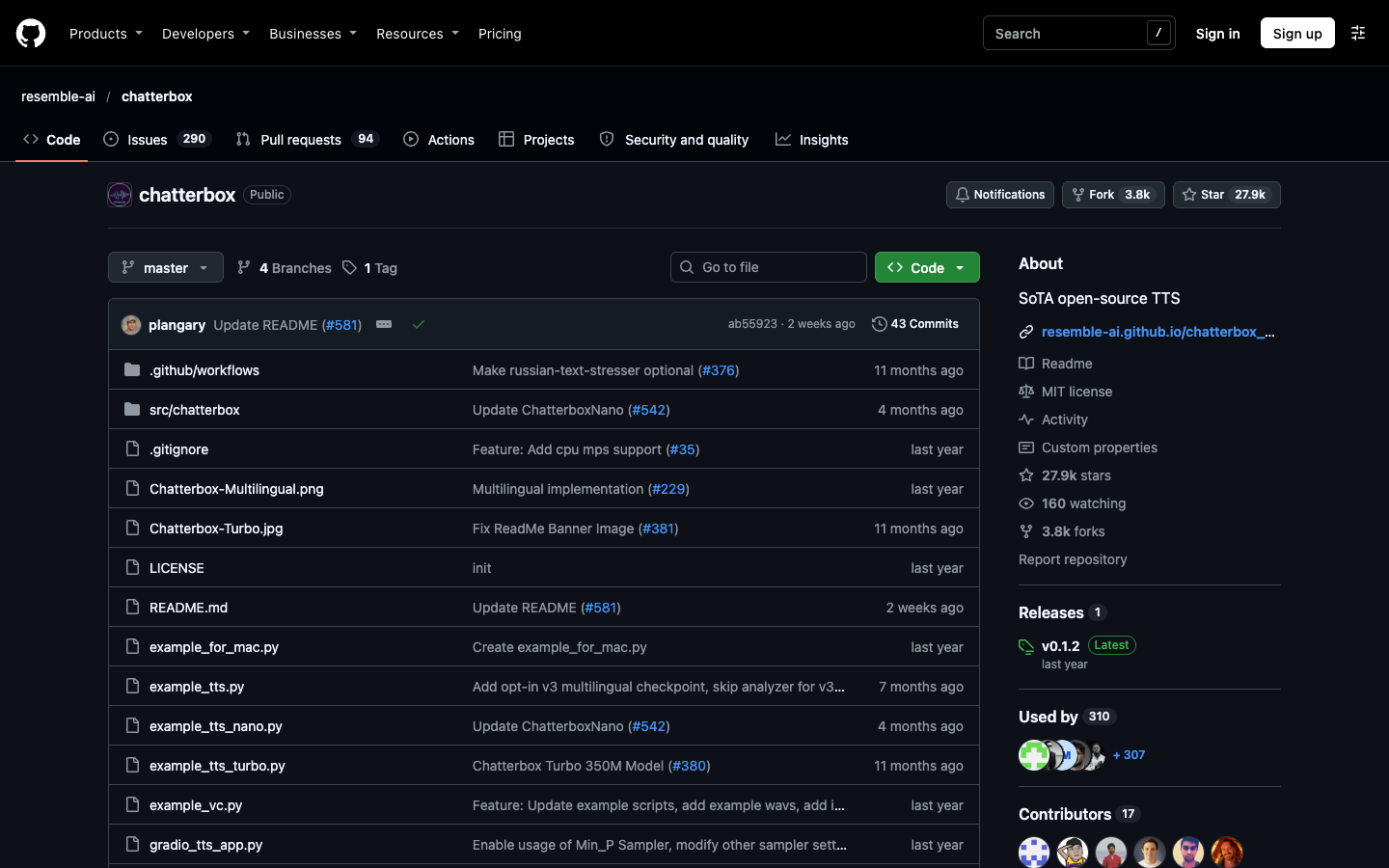
Screenshot of Chatterbox TTS website

Chatterbox TTS is a family of open-source text-to-speech models released by Resemble AI under the MIT license. It is for developers who want to run speech generation and voice cloning on their own hardware with Python. As of August 2026 the project is retired research: the code stays public as an archive with no support, updates or paid tier.

Key benefits of Chatterbox TTS include:

  • Several model sizes: Turbo (350M), Nano (110M) and Multilingual V3 (500M) cover voice agents, CPU-only devices and multilingual use.
  • Voice cloning from a reference clip: Models generate speech in a voice taken from a short reference audio sample.
  • Paralinguistic tags: Turbo and Nano support tags like [laugh], [cough] and [chuckle] inside the text.
  • Multilingual support: Multilingual V3 covers 23+ languages, plus a Single Language Pack of six dedicated finetunes.
  • CPU inference: Nano runs about 3x faster than realtime on 8 CPU cores, according to the README.

For someone leaving ElevenLabs, Chatterbox means no per-character billing and no audio sent to a third party: install it with pip install chatterbox-tts and run it locally, with Gradio demo apps included. The trade-offs are real. There is no hosted interface, you manage your own GPU or CPU setup, and the project is no longer maintained, so bugs and dependency issues will not be fixed upstream. It is best suited to teams comfortable owning and forking the code.
Read the Chatterbox TTS review

F5-TTS is an MIT-licensed text-to-speech model that generates speech from a reference audio clip and target text. It runs locally on NVIDIA, AMD, Intel or Apple Silicon hardware, with a Gradio web app, CLI and Docker images.

Free
Open-source
Self-hosted
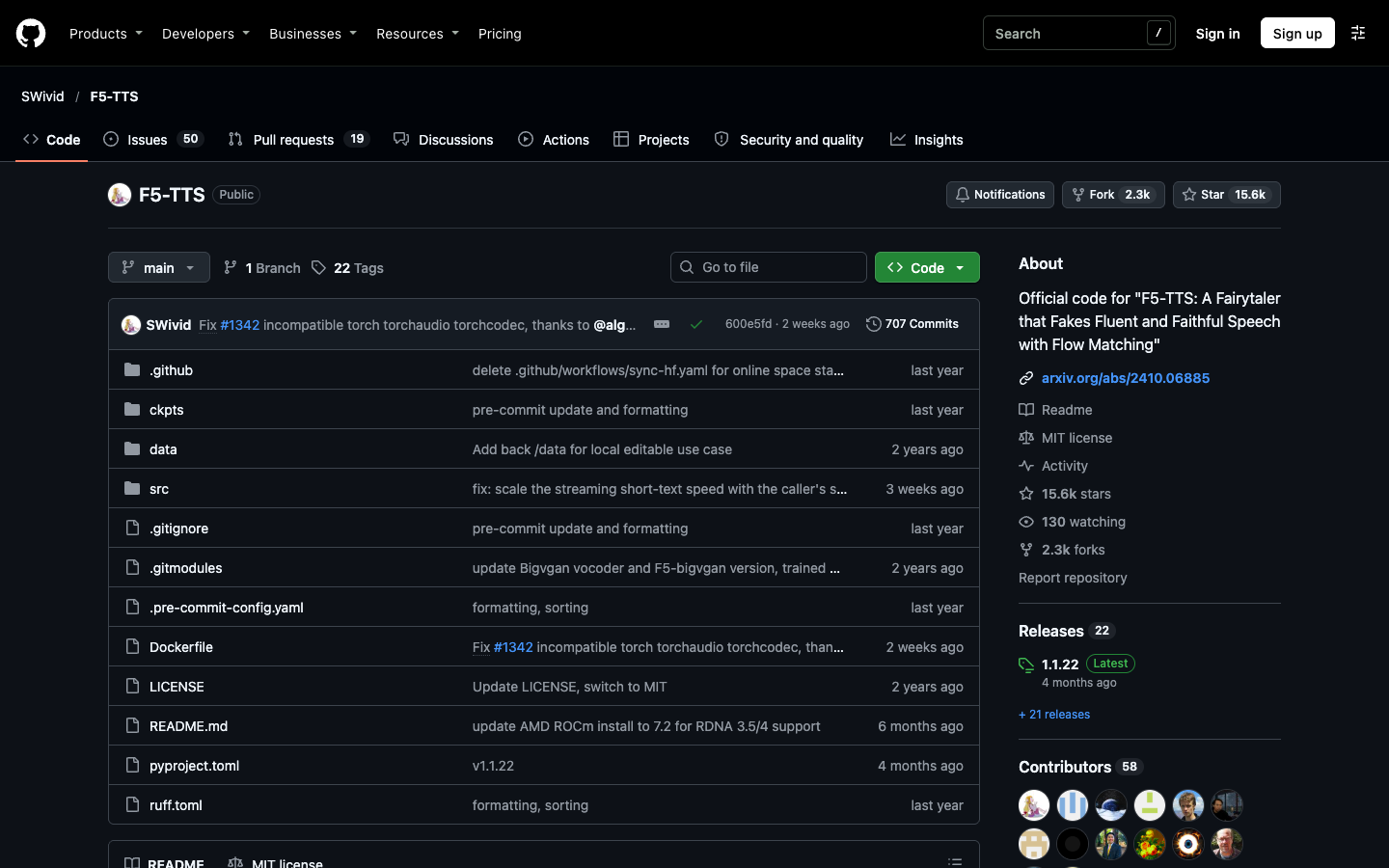
Screenshot of F5-TTS website

F5-TTS is the official code release for the research paper "F5-TTS: A Fairytaler that Fakes Fluent and Faithful Speech with Flow Matching". It is a diffusion transformer text-to-speech model that takes a prompt audio clip and target text and produces speech in that voice. It suits developers, researchers and technically comfortable creators who want to generate or clone voices on their own hardware.

Key benefits of F5-TTS include:

  • MIT licensed: The code is open source and can be self-hosted, modified and used for finetuning or training your own models.
  • Broad hardware support: Installation instructions cover NVIDIA (CUDA), AMD (ROCm on Linux), Intel GPUs and Apple Silicon.
  • Gradio web interface: A local app offers basic TTS with chunk inference, multi-style and multi-speaker generation, and a voice chat mode powered by Qwen2.5-3B-Instruct.
  • Multiple ways to run: Install via pip for inference, clone the repo for training, or use the published Docker image and compose example.
  • Production deployment path: A Triton and TensorRT-LLM runtime is provided, with a reported real-time factor around 0.04 on a single L20 GPU.

For someone leaving ElevenLabs, F5-TTS removes per-character fees and keeps reference audio and generated speech on your own machines. The trade-offs are real: you need a capable GPU, a Python or Docker setup, and some patience with configuration, and there is no hosted service, managed API or vendor support. Results depend on your reference audio and settings, and the README recommends reading its inference guidance and searching issues when problems come up.

Read the F5-TTS review

Kokoro is a lightweight open-weight text-to-speech model with 82 million parameters. Its Apache-licensed weights can be run locally via a Python package or deployed in production and commercial projects.

Free
Open-source
Self-hosted
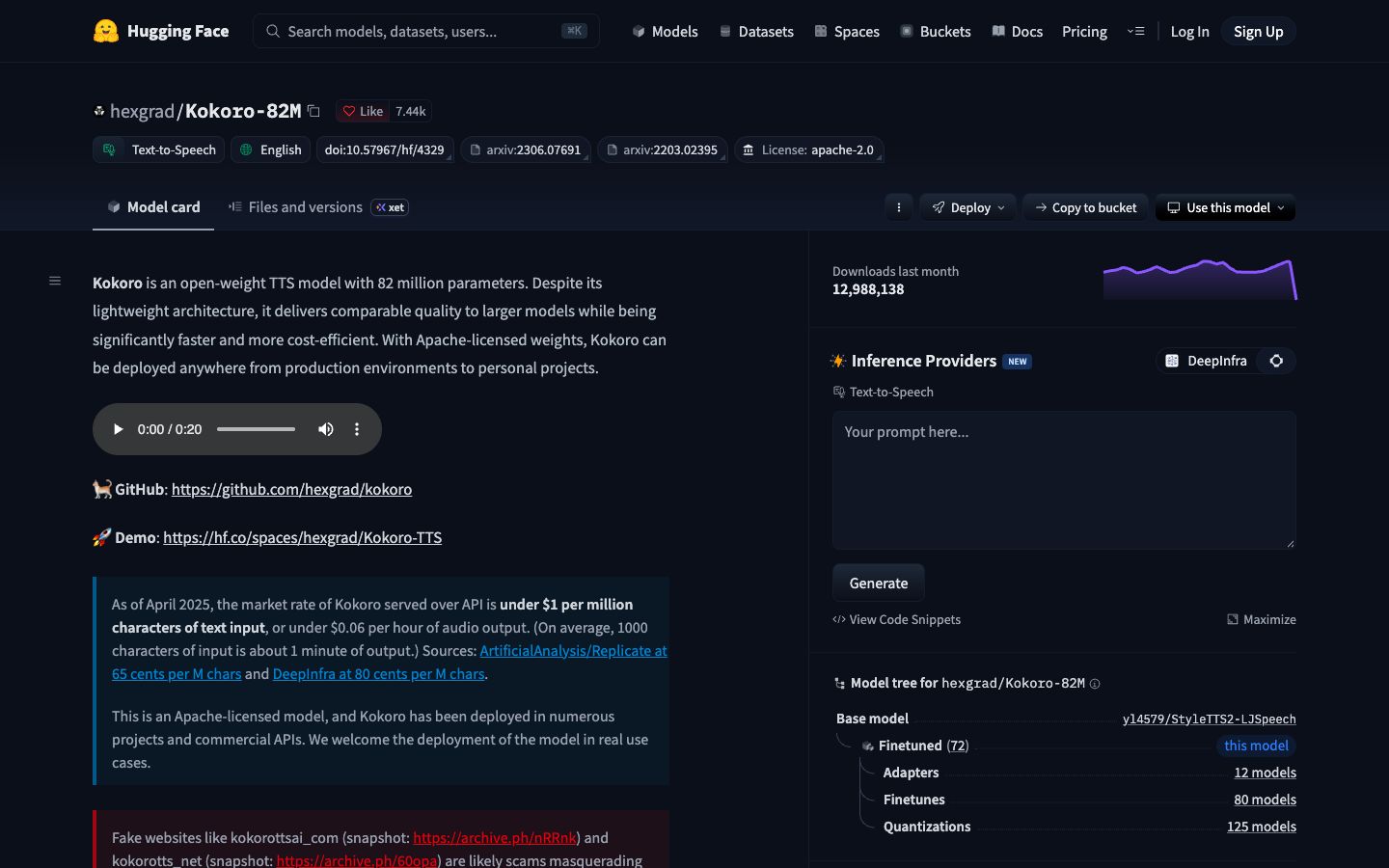
Screenshot of Kokoro TTS website

Kokoro TTS is an open-weight text-to-speech model with 82 million parameters, built on the StyleTTS 2 and ISTFTNet architectures. It is aimed at developers and hobbyists who want to generate speech from text on their own hardware or inside their own products, without paying per character to a hosted service.

Key benefits of Kokoro TTS include:

  • Apache 2.0 license: The weights can be used in personal projects, production environments and commercial APIs.
  • Small and fast: At 82M parameters it is designed to be faster and cheaper to run than larger TTS models.
  • Multiple languages and voices: Version 1.0 ships with 8 languages and 54 voices.
  • Simple Python usage: Install the kokoro package with espeak-ng and generate 24 kHz audio in a few lines of code, including on Google Colab.
  • Permissive training data: It was trained on public domain, permissively licensed and synthetic audio, with no custom voice clones.

If you are leaving ElevenLabs or Speechify, Kokoro lets you produce speech locally for free, and hosted APIs serving it are cited at under $1 per million characters. The trade-off is that it is a model, not a polished app: you need some comfort with Python or a third-party front end, and the model page does not mention voice cloning or the reading and editing features those services offer. Beware of unofficial websites with "kokoro" in their domain, which the author says are not affiliated.

Read the Kokoro TTS review

Share:

Discover the best open source alternatives to

View all

Put your SaaS product in front of active buyers

Reach developers, tech leaders and founders looking for open source tools to adopt.

Submit your product