

AdAdvertise with us·Reach an audience of professional tech enthusiasts
Favicon of Postman website

Best Popular Postman Alternatives

A curated collection of the 3 best alternatives to Postman.

3 alternatives · Updated

The best alternative to Postman is Bruno. If that doesn't suit you, we've compiled a ranked list of other Postman alternatives to help you find a suitable replacement. Other interesting alternatives to Postman are: Hoppscotch and Insomnia.

Postman alternatives are mainly Software Development but may also be API Testing. Browse these if you want a narrower list of alternatives or looking for a specific functionality of Postman.

Postman alternatives compared

#ToolPricingOpen source
1 BrunoFree + From $6/moYes
2 HoppscotchFree + From $6/moYes
3 InsomniaFree + From $12/moYes

The best Postman alternatives, ranked

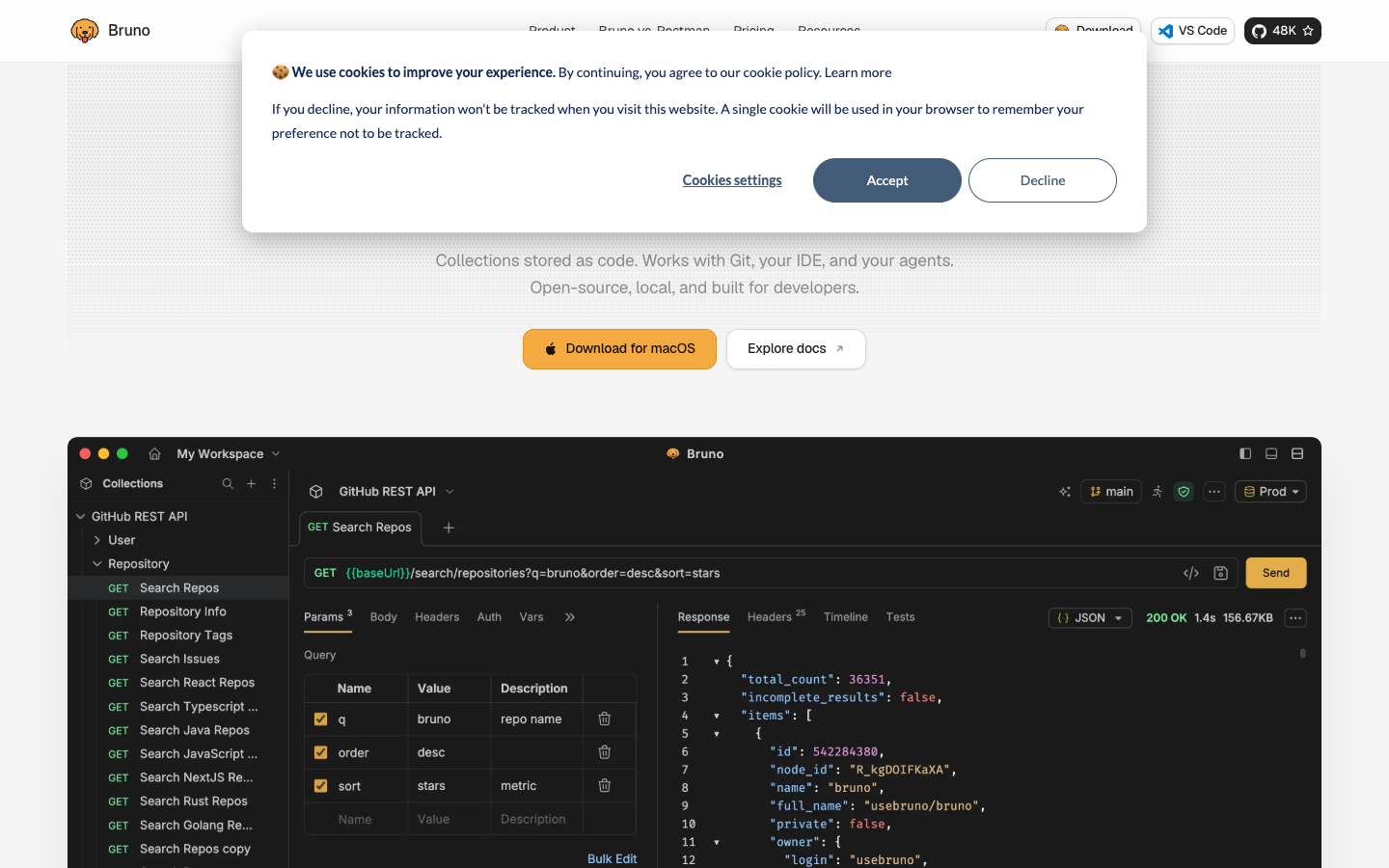
Bruno is an open-source API client for REST, GraphQL, gRPC and WebSocket that keeps collections as plain-text files on your machine. There is no cloud sync and no account required; teams share collections through Git.
Free + From $6/mo
Open-source
Screenshot of Bruno website

Bruno is an open-source, Git-native API client for REST, GraphQL, gRPC and WebSocket APIs. Instead of syncing collections to a cloud workspace, it saves them as human-readable text files (using the OpenCollection YAML format) that live in your repository next to the code they test. It suits developers and teams who want their API requests versioned, reviewed and shared with the same Git workflow they already use.

Key benefits of Bruno include:

  • Collections as code: Requests are stored as separate, diff-friendly files you can branch, review and merge.
  • Local and account-free: No cloud sync, no account and no login; the team states it has no visibility into your requests.
  • Free open-source edition: Includes the API client, testing, scripting, documentation, code generation and an unlimited collection runner.
  • Postman import: Existing Postman collections can be imported into Bruno.
  • Runs where you work: Works from the desktop app, your IDE, the terminal and AI coding agents.

For someone leaving Postman, the main draw is ownership: collections stay on your machine and in your repo, with no per-user cloud workspace. The trade-off is that collaboration happens through Git rather than a hosted workspace, so teams need to be comfortable with that workflow. Some features are paid: full Git operations in the built-in UI (commit, push, branching), data-driven testing, secret manager integrations, SSO/SCIM and unlimited workspaces require Pro ($6/user/month), Ultimate ($11) or Enterprise ($18), all billed annually. The free edition is limited to two workspaces and five OpenAPI syncs per month.
Read the Bruno review

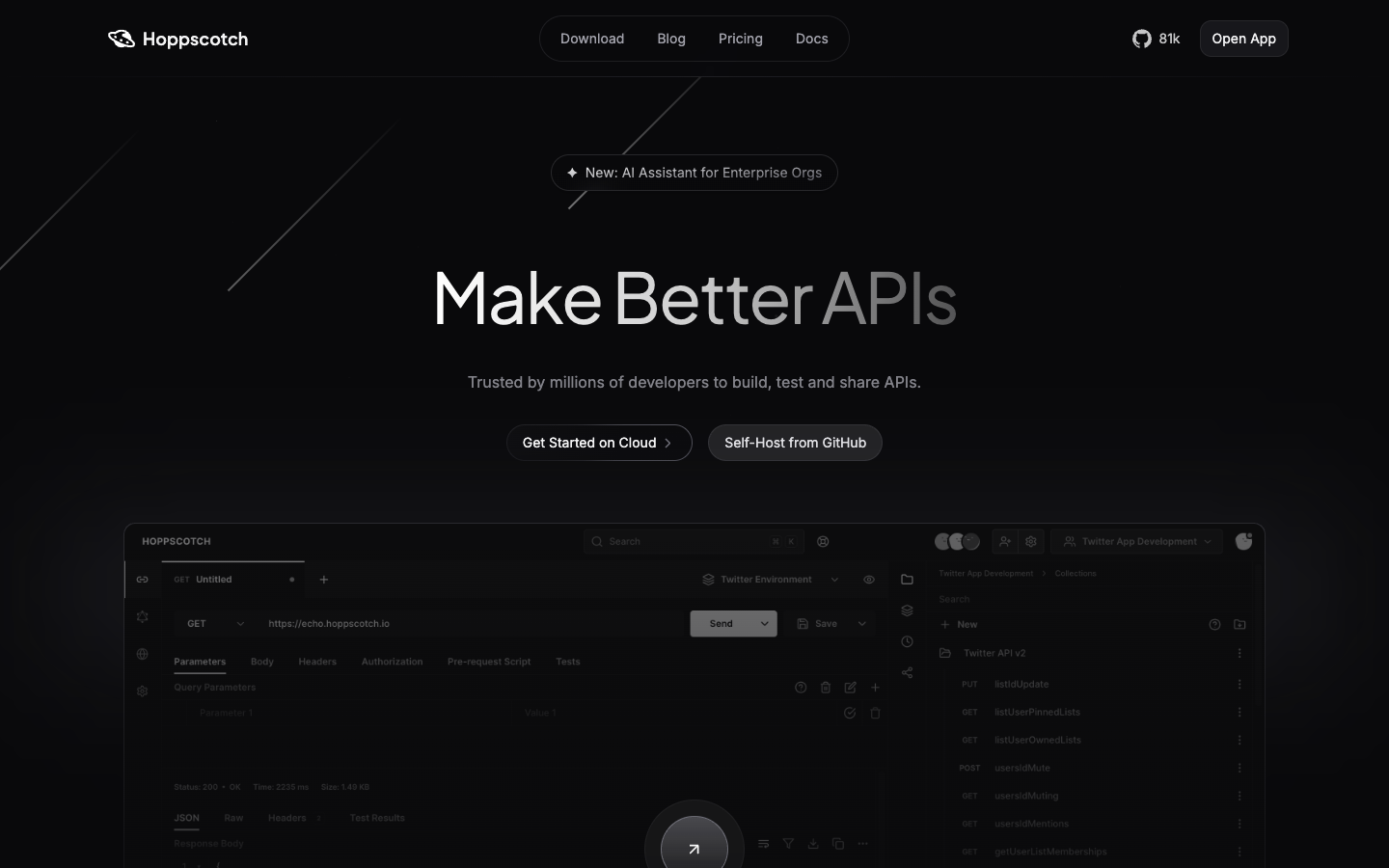
Hoppscotch is an open-source API development platform for creating, testing and sharing API requests. It runs on the web, desktop and CLI, and can be self-hosted from GitHub or used on its free cloud plan.

Free + From $6/mo
Open-source
Self-hosted
Screenshot of Hoppscotch website

Hoppscotch is an open-source API client for developers and teams who build and test APIs. It covers request building, collections, environments, scripting and tests, and runs on Mac, Windows, Linux, the web and the command line. You can use the hosted cloud version or deploy it on your own servers.

Key benefits of Hoppscotch include:

  • Multi-protocol support: Send HTTP, GraphQL, WebSocket, Socket.IO, MQTT and Server-Sent Events requests from one client.
  • Scripts and tests: Pre-request scripts modify headers, handle auth and generate data, while post-request tests let you write assertions on responses.
  • One-click migration: Import existing work from Postman, Insomnia or cURL.
  • CLI for automation: Run your requests from the terminal to fit them into scripts and workflows.
  • Privacy-focused: Local-first data storage with no tracking, analytics or ads.

For someone leaving Postman, Hoppscotch offers a familiar workflow with a free plan that includes collections, environments, scripts, a collection runner and code snippets, plus a direct import path for Postman collections. Self-hosting gives you control over where your API data lives. The trade-offs: team workspaces, real-time collaboration, documentation publishing and API mocking are part of the paid Business plan ($6 per user/month billed annually) on cloud, and features like SAML SSO, SCIM and audit logs sit in the Enterprise tier. Self-hosting means running and maintaining the deployment yourself.

Read the Hoppscotch review

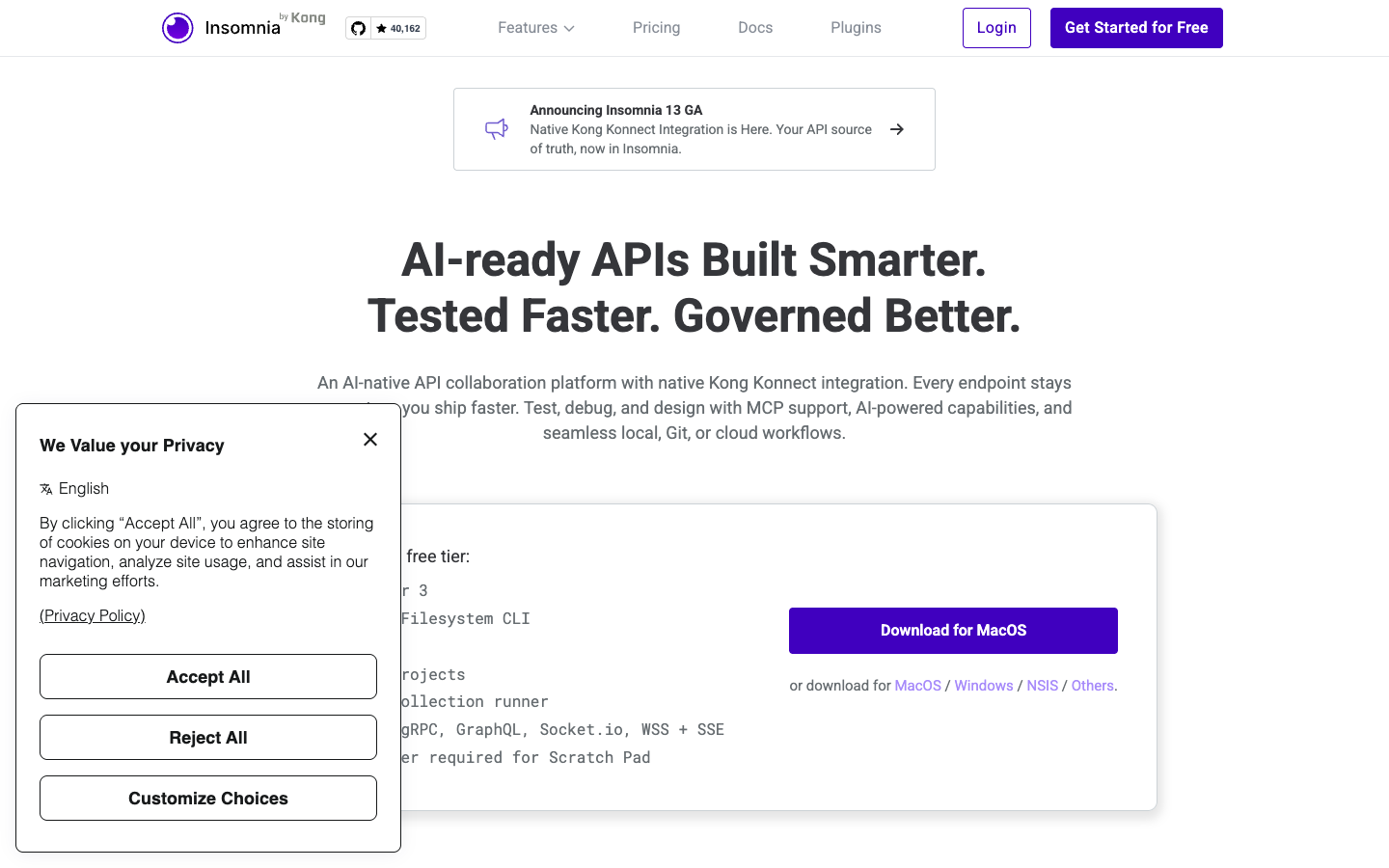
Insomnia is an open-source desktop API client from Kong for designing, debugging, mocking and testing APIs, with local, Git or cloud storage and a free tier that includes Git Sync for up to 3 users.

Free + From $12/mo
Open-source
Screenshot of Insomnia website

Insomnia is an open-source API development platform maintained by Kong. It is a desktop client for sending and debugging requests over HTTP/REST, GraphQL, gRPC, SOAP, WebSockets, Socket.IO and SSE, and it also covers OpenAPI design, mocking, automated testing and MCP server testing. It suits individual developers and teams who want a Postman-style tool with more control over where their data lives.

Key benefits of Insomnia include:

  • Flexible storage: Keep collections and specs locally, in your own Git repository, or in Insomnia's cloud with optional end-to-end encryption.
  • No-login Scratch Pad: A local-only, free forever mode lets you send requests without creating an account.
  • Unlimited collection runs: Run collection tests with pre- and after-request scripting on every plan, including the free one.
  • Inso CLI for CI/CD: Lint and validate OpenAPI specs and run tests inside Git pipelines.
  • MCP client: Connect to MCP servers, inspect tools, resources and prompts, and run tools with custom parameters.

For someone leaving Postman, Insomnia offers a familiar collections-and-environments workflow, a documented migration path for Postman collections, and the option to work fully offline or store everything in Git. The trade-offs: Git Sync on the free Essentials plan is limited to 3 users, mock servers are capped at 1,000 requests per month, and features like RBAC require Pro ($12 per user/month) while SSO, SCIM and vault integrations are Enterprise-only. Some newer features are tied to Kong's Konnect platform, which matters less if you don't use Kong.

Read the Insomnia review

Frequently asked questions

What is the best alternative to Postman?

The top-rated alternative to Postman is Bruno. Bruno is an open-source API client for REST, GraphQL, gRPC and WebSocket that keeps collections as plain-text files on your machine. There is no cloud sync and no account required; teams share collections through Git. Other popular options include Hoppscotch, Insomnia. Compare features and pricing in the table above.

How many alternatives to Postman are there?

There are 3 alternatives to Postman listed on YouMightNotNeed, including Bruno, Hoppscotch, Insomnia. Each listing is hand-reviewed and includes a description, screenshot, pricing, and open-source status.

Are there free alternatives to Postman?

None of the Postman alternatives listed on YouMightNotNeed is fully free, though some offer free tiers or trials.

Are there open-source alternatives to Postman?

Yes, there are 3 open-source alternatives to Postman: Bruno, Hoppscotch, Insomnia. Open-source tools can usually be self-hosted, so you keep full control of your data.

Share:

Discover the best alternatives to

View all

Put your SaaS product in front of active buyers

Reach developers, tech leaders and founders looking for open source tools to adopt.

Submit your product