
AdAdvertise with us·Reach an audience of professional tech enthusiasts
Favicon of Microsoft Office website

Best Popular Microsoft Office Alternatives

A curated collection of the 4 best alternatives to Microsoft Office.

4 alternatives · Updated

The best alternative to Microsoft Office is CryptPad. If that doesn't suit you, we've compiled a ranked list of other Microsoft Office alternatives to help you find a suitable replacement. Other interesting alternatives to Microsoft Office are: LibreOffice, Nextcloud and ONLYOFFICE.

Microsoft Office alternatives are mainly Office Suite but may also be Desktop Apps or File Hosting. Browse these if you want a narrower list of alternatives or looking for a specific functionality of Microsoft Office.

Microsoft Office alternatives compared

#ToolPricingOpen source
1 CryptPadFree + From $5/moYes
2 LibreOfficeFreeYes
3 NextcloudFreeYes
4 ONLYOFFICEFree + From $12.42/moYes

The best Microsoft Office alternatives, ranked

CryptPad is an open-source collaborative office suite where documents, sheets, kanbans, forms and files are end-to-end encrypted. Use a free public instance, self-host it, or pay for the flagship CryptPad.fr service.
Free + From $5/mo
Open-source
Self-hosted
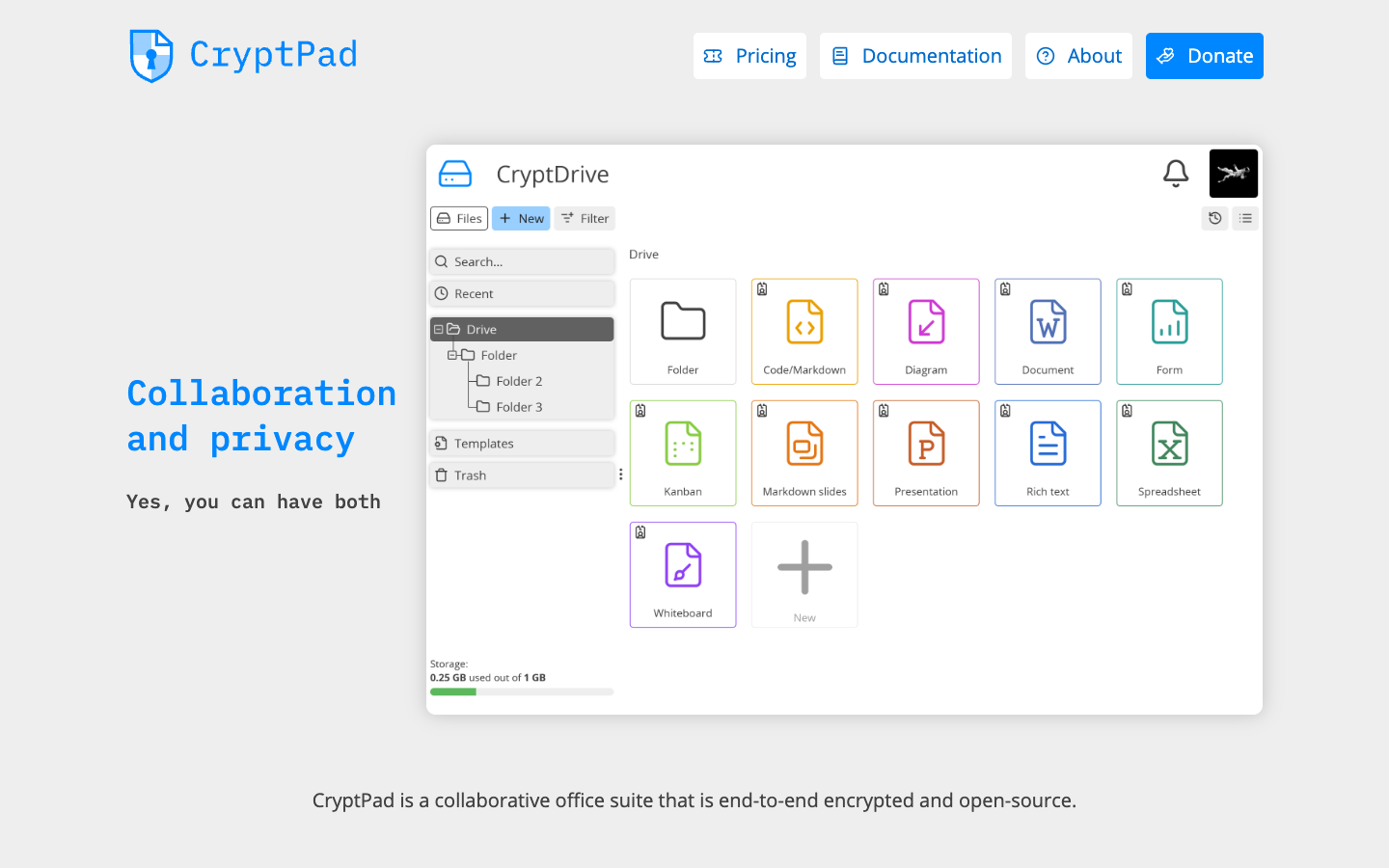
Screenshot of CryptPad website

CryptPad is an end-to-end encrypted, open-source office suite for real-time collaboration in the browser. It suits individuals, associations, schools, NGOs and companies that want shared documents without handing their content to the service provider. Its apps include Rich Text, Sheet, Code/Markdown, Presentation, Form, Kanban and Diagram, with files organised in an encrypted drive.

Key benefits of CryptPad include:

  • End-to-end encryption: Documents are encrypted so the server hosting them cannot read the content.
  • Real-time collaboration: Several people can edit the same document at once, and sharing works without everyone needing an account.
  • Free options: You can use a free account on a public instance or self-host the open-source code.
  • Paid hosting if needed: The flagship CryptPad.fr offers plans from €5 to €100 per month with more storage and priority support.
  • Managed instances for organisations: XWiki SAS runs dedicated instances with custom domains, branding, SSO and storage controls, with 50% off for education and nonprofits.

For people leaving Google Workspace or Microsoft Office, CryptPad's main draw is privacy: your documents are not readable by the host, and you can run your own server. It covers the everyday basics of documents, spreadsheets, presentations, forms and kanbans in one place. The trade-off is that it is a lighter, browser-based suite, so heavy users of advanced Office or Google features and integrations may find gaps, and free public instances come with limited storage.
Read the CryptPad review

LibreOffice is a free and open-source office suite from The Document Foundation, bundling a word processor, spreadsheet, presentation tool, drawing app, database manager and formula editor.

Free
Open-source
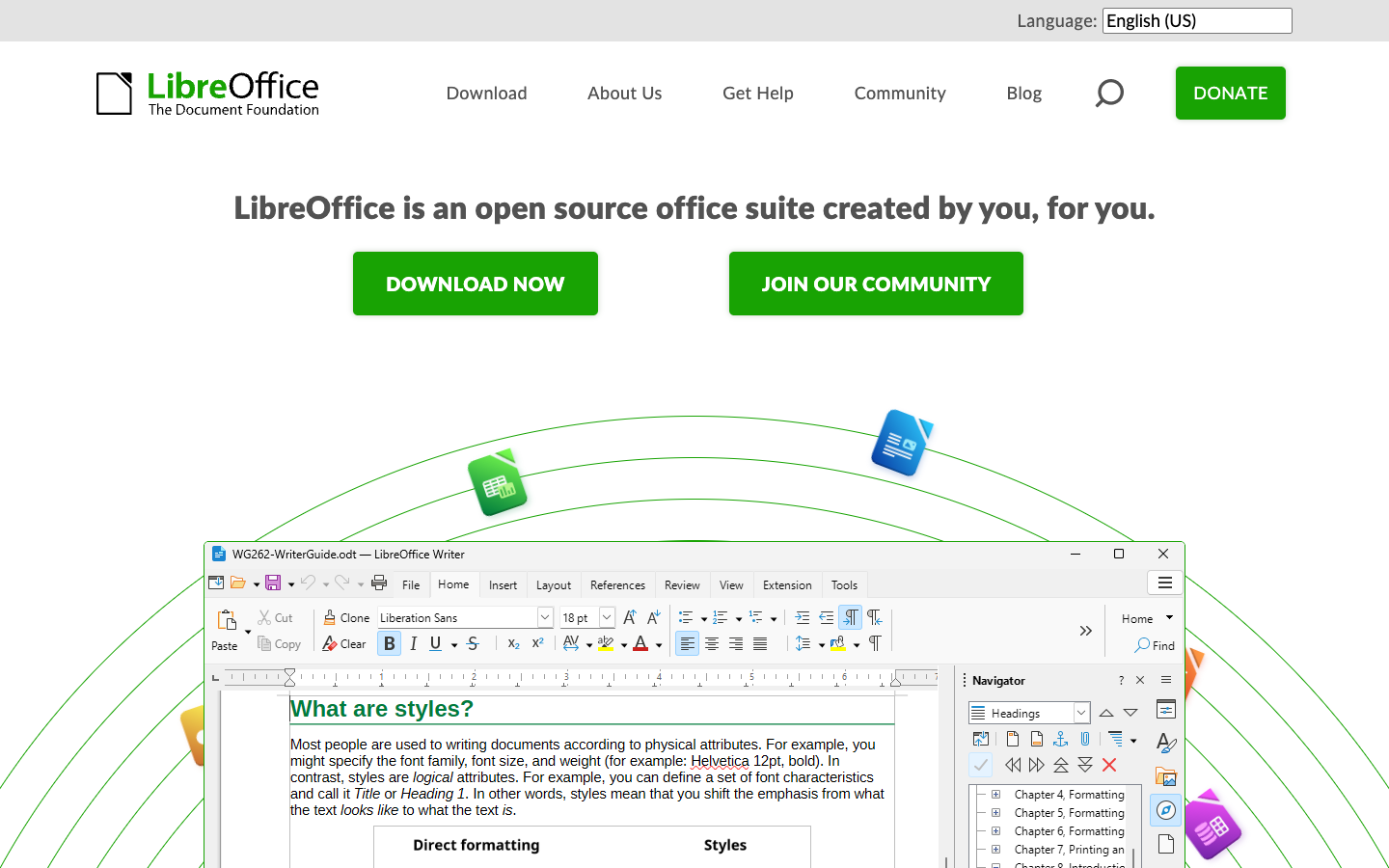
Screenshot of LibreOffice website

LibreOffice is a free, open-source office suite developed by a community of hundreds of contributors and backed by The Document Foundation. It is for individuals, schools and businesses who want a full desktop office package without licence fees or subscriptions. It is based on OpenOffice.org, and its source code is licensed under the Mozilla Public License v2.0.

Key benefits of LibreOffice include:

  • Six tools in one suite: Writer (documents), Calc (spreadsheets), Impress (presentations), Draw (diagrams and illustrations), Base (databases) and Math (formulas).
  • No cost: All tools are available to download and use for free, for both personal and business use.
  • Private, no forced AI: The project describes itself as a private office suite that does not push AI features on users.
  • Wide language support: The community translates and documents the software in many languages.
  • Open development: Anyone can study the code, contribute improvements, and get help through community assistance, documentation and optional professional support.

For someone leaving Microsoft Office, LibreOffice covers the core desktop tasks of writing, spreadsheets and presentations with no subscription, and Base offers a counterpart to Access. It uses the OpenDocument format by default. The trade-offs: it is primarily a desktop application rather than a cloud collaboration platform, the interface and some features differ from Microsoft's apps, and complex Office files with heavy formatting or macros may not always open exactly as intended, so test your key documents before switching fully.

Read the LibreOffice review

Nextcloud is an open source content collaboration platform you can self-host, combining file sync and share, video calls and chat, groupware, online office editing and a local AI assistant.

Free
Open-source
Self-hosted
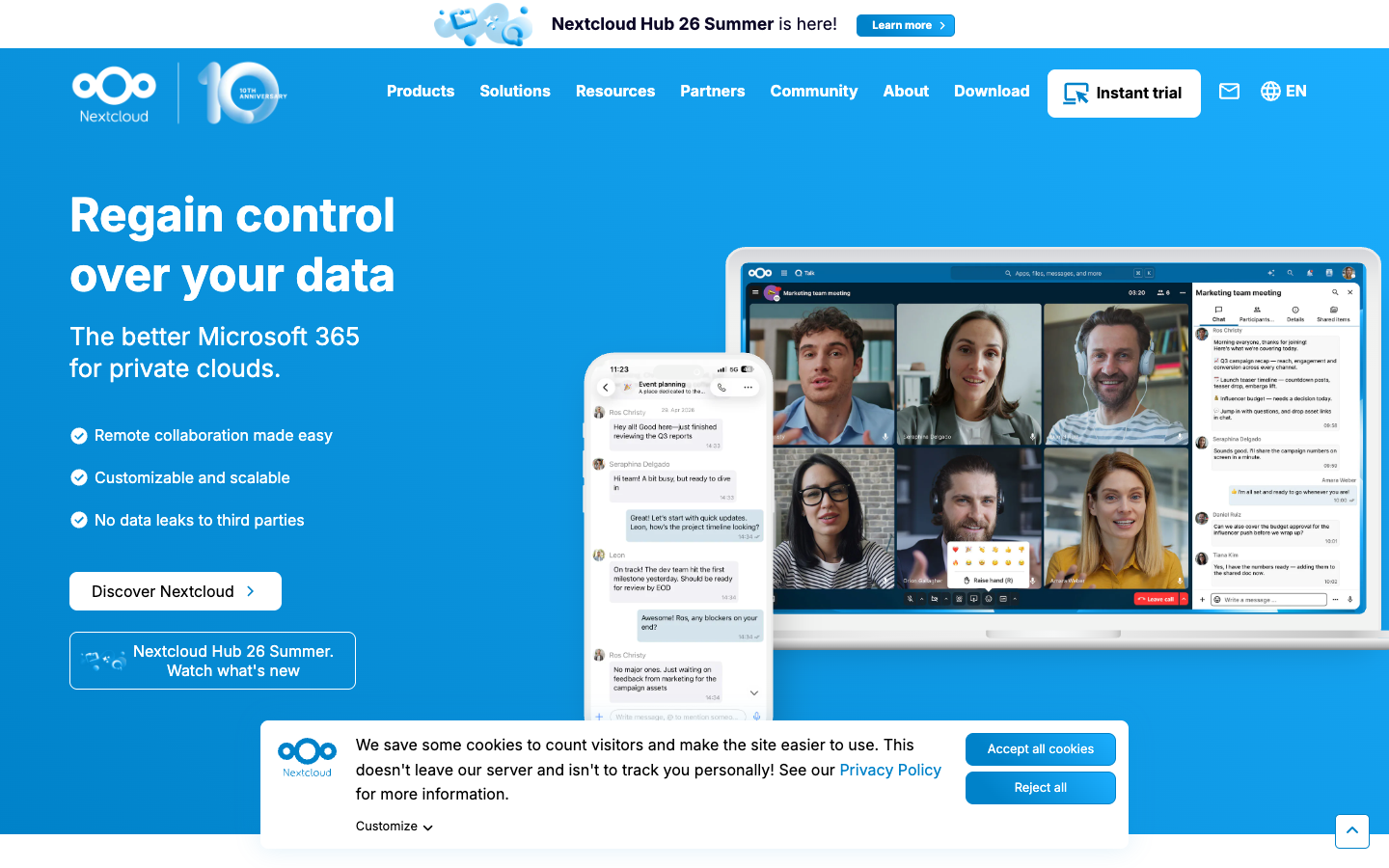
Screenshot of Nextcloud website

Nextcloud is an open source (AGPL) collaboration platform that you run on your own server or get through a hosting provider. Nextcloud Hub bundles Files, Talk, Groupware, Office, Assistant and Flow into one workspace. It is used by individuals and families as well as companies, schools, service providers and public sector bodies, and the project reports over 400,000 deployments, scaling from a Raspberry Pi with 2 users to installations with tens of millions of users.

Key benefits of Nextcloud include:

  • File sync and share: Store and sync files through web, desktop (Windows, macOS, Linux) and mobile (Android, iOS) clients.
  • Talk and Groupware: Chat, audio/video calls with screen sharing and SIP integration, plus calendar, contacts and mail.
  • Online office: Collaborative editing of docx, xlsx and pptx files in the browser, with options such as Collabora Online and Euro-Office.
  • Local AI assistant: Nextcloud Assistant can summarize emails, translate, generate content and answer questions about your data without sending it to a third party.
  • Data control: Keep data on servers you own, with encryption, access control, auditing and compliance tooling.

If you are leaving Google Workspace, Dropbox or Microsoft 365, Nextcloud covers storage, communication and document editing in one self-hostable package, with an app store of hundreds of add-ons. The trade-off is that self-hosting means you handle installation, updates, backups and security yourself, and the office editing and AI features need extra components and server resources. Organizations that want vendor support can buy Nextcloud Enterprise, which starts at 100 users and is billed per user per year; individuals can also sign up for a free account at a provider.

Read the Nextcloud review

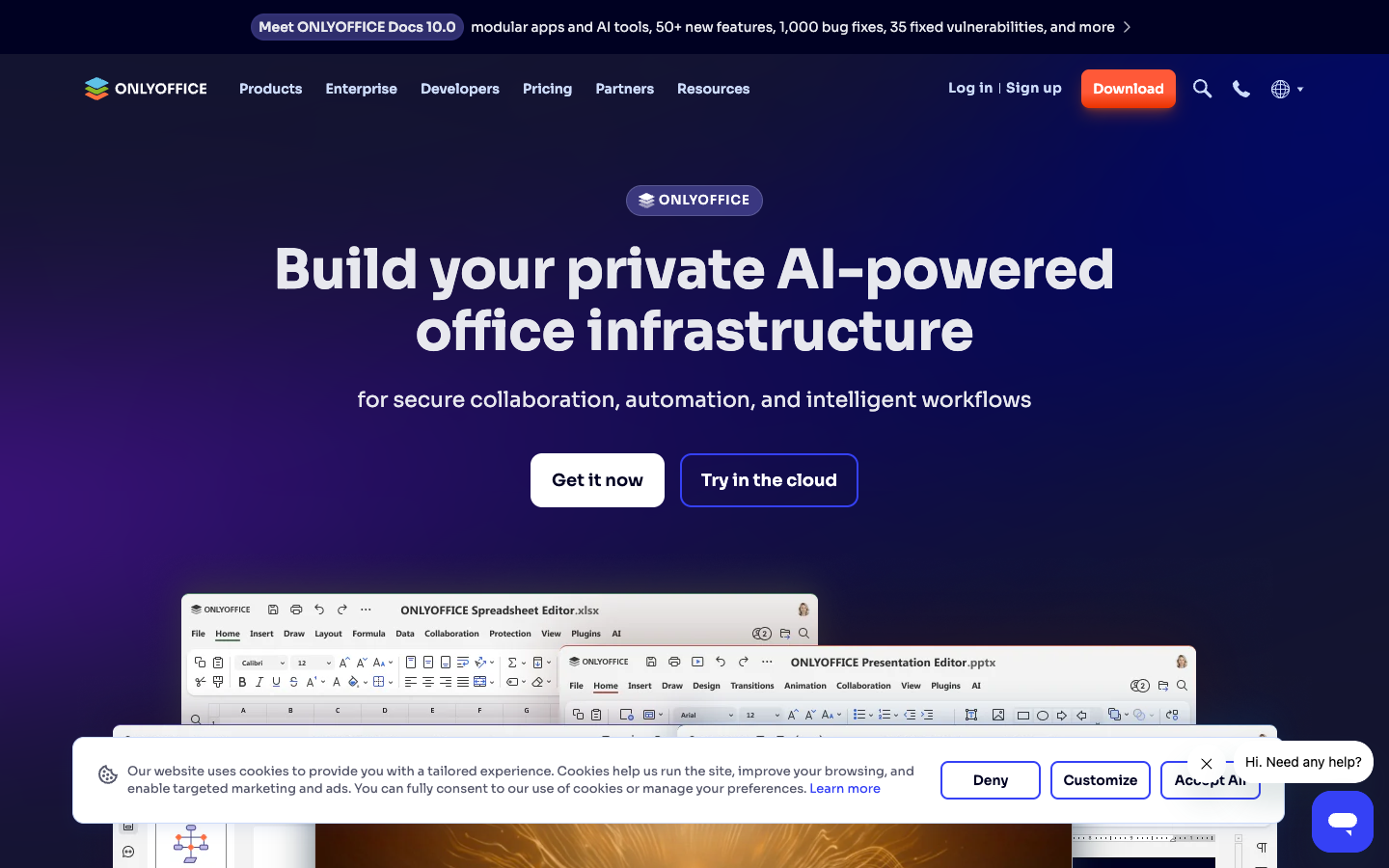
ONLYOFFICE is an open-source office suite for editing and co-editing documents, spreadsheets, presentations, PDFs and forms on web, desktop and mobile. It can be self-hosted or used in the cloud.

Free + From $12.42/mo
Open-source
Self-hosted
Screenshot of ONLYOFFICE website

ONLYOFFICE is an open-source office suite from Ascensio System SIA for creating, editing and collaborating on text documents, spreadsheets, presentations, PDF forms and PDF files. It runs in the browser, on Windows, Linux and macOS desktops, and on Android and iOS. It suits organizations that want to keep documents on their own servers, and developers who want to embed editors into their own platforms.

Key benefits of ONLYOFFICE include:

  • Self-hosting: ONLYOFFICE Docs can be deployed on private servers, and the Docker image has over 101 million pulls.
  • Free desktop and mobile apps: The Desktop Editors work offline on Windows, Linux and macOS, with free apps for Android and iOS.
  • Real-time co-editing: Teams can work on the same document together, with rooms, granular permissions and guest access.
  • Integrations: More than 50 ready connectors for platforms such as Confluence and Odoo, plus an API and WOPI support for embedding.
  • Optional AI tools: AI agents for writing, summarization and search, with MCP server integration.

For people leaving Google Workspace or Microsoft Office, ONLYOFFICE offers familiar editors for Office-style files plus the option to keep data on infrastructure you control, with no ads. The trade-offs: it is an office suite rather than a full workspace, so email and calendar need other tools, and self-hosted collaboration features for organizations are tied to paid plans. The Home self-hosted plan costs $149 per server per year for up to 10 users, while Enterprise starts from $33 per connection per year with a 50-connection minimum. White labeling is limited to the Developer edition as a paid add-on.

Read the ONLYOFFICE review

Frequently asked questions

What is the best alternative to Microsoft Office?

The top-rated alternative to Microsoft Office is CryptPad. CryptPad is an open-source collaborative office suite where documents, sheets, kanbans, forms and files are end-to-end encrypted. Use a free public instance, self-host it, or pay for the flagship CryptPad.fr service. Other popular options include LibreOffice, Nextcloud, ONLYOFFICE. Compare features and pricing in the table above.

How many alternatives to Microsoft Office are there?

There are 4 alternatives to Microsoft Office listed on YouMightNotNeed, including CryptPad, LibreOffice, Nextcloud. Each listing is hand-reviewed and includes a description, screenshot, pricing, and open-source status.

Are there free alternatives to Microsoft Office?

Yes, there are 2 free alternatives to Microsoft Office: LibreOffice, Nextcloud.

Are there open-source alternatives to Microsoft Office?

Yes, there are 4 open-source alternatives to Microsoft Office: CryptPad, LibreOffice, Nextcloud, ONLYOFFICE. Open-source tools can usually be self-hosted, so you keep full control of your data.

Share:

Discover the best alternatives to

View all

Put your SaaS product in front of active buyers

Reach developers, tech leaders and founders looking for open source tools to adopt.

Submit your product